
Goats in Pakistan: Popular Breeds, How to Buy a Healthy Goat, Winter Care, Feed and Vaccines
2026-11-28 · 11 min read
📖 اردو میں پڑھیں
In Pakistani villages it is often said that a goat is a poor family's bank. Goats need little space, eat leaves and fodder that other animals leave, give milk, have kids quickly, and can be sold whenever money is needed — and every year demand jumps before Eid ul Adha. Pakistan has one of the largest goat populations in the world. Whether you keep two goats at home or plan a small farm, this guide covers the basics.
Popular goat breeds of Pakistan
- Beetal: the best-known breed of Punjab — large, with long hanging ears and a curved nose; black, brown or spotted (types like Makhi Cheeni and Nukri). Good for both milk and meat, and a favourite for Qurbani.
- Teddy: a small Punjab breed that often gives twins or triplets and grows fast — popular with small farmers.
- Kamori: from Sindh — tall, with very long ears and brown patches; known for milk.
- Dera Din Panah: from southern Punjab — black, with long ears and long hair; a good milker.
- Nachi: from the Cholistan and Bahawalpur side, famous for its "dancing" walk.
- Pateri: from Sindh — a white body with a brown head and neck.
- Barbari: small and spotted, kept in towns as well; good milk for its size.
- Hill goats of Khyber Pakhtunkhwa (such as Kaghani): hardy, with long hair, suited to cold mountains.
Signs of a healthy goat
- Bright, clear eyes. Gently pull down the lower eyelid: the inside should be pink-red. Very pale means weakness, often from worms.
- Clean nose and mouth — no thick discharge, no sores.
- Active and alert, eats well and chews the cud while resting.
- Smooth, shiny coat, no bald patches, lice or ticks.
- Droppings are firm pellets, not loose or smelly.
- Walks without limping; hooves are not overgrown.
- For a female: the udder is soft on both sides, with no hard lumps.
Telling age by the teeth
A young goat has small milk teeth in the lower front jaw. These are replaced by pairs of large permanent teeth: the first pair usually comes at around 1 to 1.5 years ("do daant"), then another pair roughly every year. This gives only an approximate age.
For Qurbani: a goat must be at least one full year old. Many buyers look for two permanent front teeth as a sign; if you are unsure, ask a local scholar.
Winter care
- Cold is not the main enemy — wet and wind are. A dry goat out of the wind handles a Pakistani winter well. How to cover the shed without trapping gas is explained in the next section.
- Dry bedding: straw or husk on the floor, and change it when it gets wet. Goats hate wet ground.
- Newborn kids get cold fast. Make sure each kid drinks the mother's first milk (colostrum) within the first hours, and keep it warm and dry.
- Clean water every day — not ice-cold. In very cold mornings, lukewarm water helps them drink.
- A little more feed in winter for energy, and graze after the frost has melted.
Warm but fresh: covering the shed without ammonia
When it gets cold, many people wrap the whole shed in plastic or sacks. It feels warm, but the goats' urine and droppings on the floor give off ammonia gas. In a closed shed this gas builds up, burns the eyes and lungs, and is one of the main causes of coughing, runny eyes and pneumonia in winter — especially in kids.
Simple test: bend down to the height of a goat's head when you walk in early in the morning. If the smell is sharp or your eyes sting, there is too much ammonia — the shed needs more air and drier bedding.
1. Block the wind low, let air out high. Cover the side facing the cold wind (usually north and west) from the floor up to a little above the goats' height with sacks (bori), a tarpaulin or a reed or bamboo curtain. Keep the top part, just under the roof, open — a gap of a few inches along the top, or a vent in the roof. Warm, damp air and ammonia rise and leave from there, while the goats stay out of the draught.
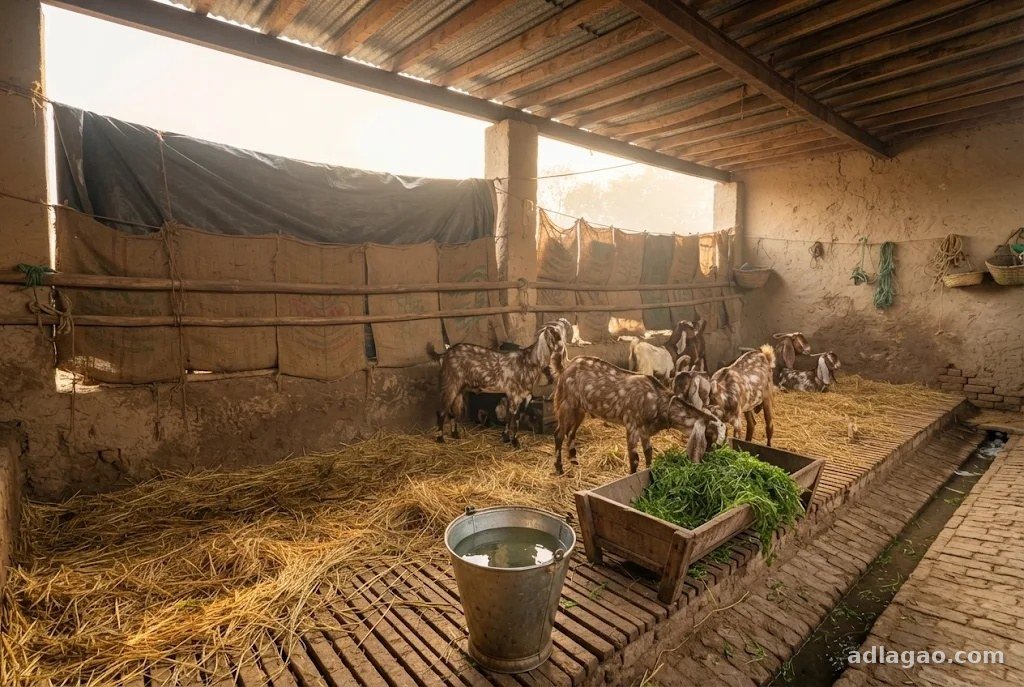
2. Never seal every side. Do not close all walls with plastic, especially at night. Plastic also traps moisture, which makes bedding wet and the gas worse.
3. Keep the floor dry. A floor that slopes gently to a drain lets urine run out. Even better is a raised slatted floor (machan), so urine and droppings fall through — see the next section.
4. Bedding: thick, dry and changed. Use a thick layer of straw, rice husk or sawdust. Remove wet and dirty patches every day, add a fresh dry layer on top, and clean the whole floor at least once a week. Keep the manure heap outside, away from the shed.
5. Lime only on a clean, dry floor. Some farmers sprinkle a little lime (chuna) on the floor after cleaning and drying it, before fresh bedding. Use only a thin layer, never on wet bedding, and keep it away from the goats' eyes and skin.
6. Don't crowd them. Give each adult goat about 15–20 square feet of floor space indoors. Too many goats in a small room means more urine, more damp and more gas.
7. Open up in the sunny hours. On sunny days, roll up the curtains around midday so sunlight and fresh air dry the shed, and close the windward side again in the evening.
8. Extra warmth for kids only — safely. Make a draught-free corner or box with deep straw for newborn kids; an old jute sack or sweater can be used as a small coat. If you use a bulb or electric heater, fix it high and away from straw, because straw catches fire very easily. And again: no coal or wood fire inside a closed shed.
Raised sheds: why new goat sheds are built 4–6 feet above the ground
Many new goat farms in Pakistan now keep their goats on a raised slatted floor (machan) built 4 to 6 feet above the ground, on brick or concrete pillars, steel or strong bamboo. It costs more at the start, but it solves many problems at once:
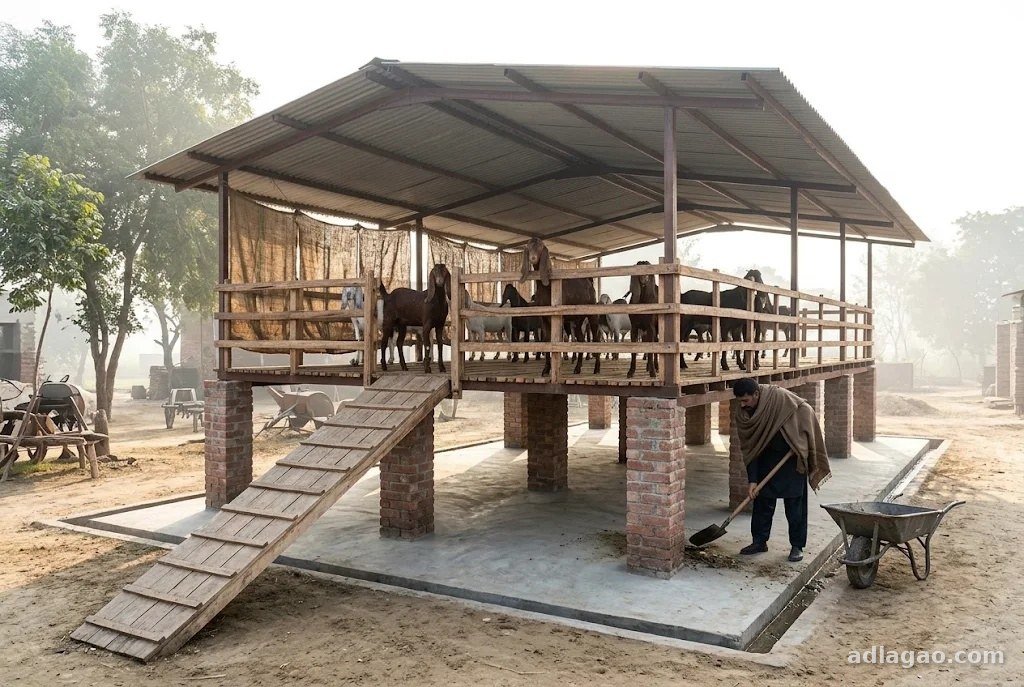
- Dry floor, much less ammonia. Urine and droppings fall through the gaps between the slats, so the goats never stand or sleep in them.
- Fewer diseases. Less pneumonia, diarrhoea, foot rot and worm infection, because the goats are away from wet, dirty ground where worm eggs live. Fewer ticks too.
- Fresh air from below and above keeps the shed cooler in summer and drier in the monsoon.
- Safe from floods and waterlogging after heavy rain — very important in low areas.
- Easier cleaning, less straw. Manure collects underneath; a 6-foot height lets a person stand and clean with a shovel or wheelbarrow. The manure is good fertilizer you can use or sell.
- Some protection from dogs, jackals and snakes, especially at night.
Plastic slat floors (plastic pallets) — the modern choice. Many farms now use plastic slatted floor panels instead of wood or bamboo, so urine and droppings go straight down and the shed stays clean:
- They do not rot or soak up urine like wood, have no splinters or nails, and are easy to wash with water.
- The top is smooth but non-slip, and warmer to lie on than iron mesh; the gaps are even everywhere.
- Light, quick to fit and last for many years — they cost more than bamboo at the start, but save on repairs, straw and medicine.
Tips for plastic floors:
- Lay the panels on a strong frame (iron or concrete beams) at the spacing the seller gives — a panel without enough support bends and breaks.
- Choose thick, strong, UV-protected plastic with a non-slip top. Cheap, brittle plastic can crack in cold weather.
- Holes or gaps of about 1.5–2 cm. If you reuse ordinary shipping pallets, check that the gaps are not wide enough to trap a kid's leg, and that they never carried chemicals.
- Even a ground-level shed can use them: put the panels on a low frame over a cemented floor that slopes to a drain.
- Wash the panels and the floor underneath regularly; lift a panel when you need to clean below it.
How to build it right:
- Gap between the slats: about 1.5–2 cm (half to three-quarters of an inch) — wide enough for droppings to fall, narrow enough that kids' legs and hooves do not get stuck. Slats about 2–3 inches wide, smooth, without sharp edges or nails sticking out.
- Strong slats: plastic slat panels, hardwood or thick bamboo. Replace any broken slat or panel at once — it can break a leg.
- Side walls or railings about 4 feet high so goats cannot fall or jump off.
- A gentle ramp with cross-strips for the goats to walk up and down.
- A roof with a wide overhang so rain does not blow onto the floor.
- Under the floor: a cemented or firm floor that slopes to a drain, so urine runs away. Remove the manure at least once a week. This is the best place to sprinkle lime — where the goats cannot touch it.
In winter: cold wind can blow up through the slats. Cover the open sides under the platform on the windward side with sacks or a tarpaulin, and give newborn kids a closed corner with a solid board floor and deep straw. Keep the top of the shed open for fresh air, as explained above.
Feed
- Green fodder: berseem, lucerne and oats in winter; maize, jowar and grasses in summer.
- Leaves: goats love to browse — kikar, ber and other tree leaves are excellent.
- Dry fodder: wheat straw (toori), always together with some green fodder.
- Concentrate: khal (oil cake) or ready feed (wanda) — a little, especially for milking and pregnant goats.
- Mineral mixture and salt, and clean water all the time.
- Change the feed slowly over 7–10 days. A sudden large amount of grain, wheat or fresh green fodder can cause dangerous bloating.
Vaccines and deworming
Ask your nearest government veterinary hospital or a qualified vet for the right schedule in your area. The most important ones usually are:
- PPR (goat plague) — spreads fast and kills many goats.
- Enterotoxaemia (ET) — causes sudden death, especially in well-fed, fattening animals.
- Foot-and-mouth disease (FMD).
- CCPP (a lung disease) in some areas.
- Deworming every few months, as your vet advises.
Call a vet at once if a goat stops eating, stops chewing the cud, has a swollen left belly, fever, a cough with discharge, bad diarrhoea, or cannot stand. Keep a sick goat away from the others.
Buying a goat — checklist
- See the goat in daylight and watch it walk.
- Check the eyes, nose, teeth, hooves, coat and droppings as above.
- Ask the breed, age, and vaccination and deworming record. For a milking goat, see it being milked.
- Weigh it on a scale if the price is by weight. Be careful: some sellers give lots of salt and water, or injections, just before a sale to make an animal look heavier.
- Keep a new goat separate for 2–3 weeks before mixing it with your other animals.
- Never pay an advance online for an animal you have not seen — before Eid, many fake ads use stolen photos.
Selling goats on AdLagao
Post in Goats & Sheep and write:
- Breed, age (teeth), gender and weight.
- Vaccination and deworming done, and whether she is pregnant or giving milk.
- Your price and your city or village.
- Clear photos in daylight from the side and the front — and a short video of the goat walking.
Planning for Eid ul Adha 2027 (around the middle of May, depending on the moon)? Buyers start looking months ahead — a good goat raised from now sells best, and you can also list it in Qurbani Animals closer to Eid. Read also how to avoid online fraud, and post a free ad today.
More articles
 🐄 AnimalsEN · اردو
Businesses for Goat Farming
Encourage people and businesses for Goat Farming
2026-11-02 · 3 min read
 🐄 AnimalsEN · اردو
Green Conure Parrots in Pakistan: Buying and Care Guide for Beginners
Thinking of buying a conure? Which type to choose, how to check a healthy bird, safe buying, food, cage and care in Pak…
2026-10-25 · 5 min read