
How to Start a Poultry Farm in Pakistan: Complete Broiler Feasibility — Sheds, Chicks, Feed, Vaccines, Solar, Costs and Profit
2026-11-28 · 14 min read
📖 اردو میں پڑھیں
Chicken is the meat most Pakistani families can still afford, and broiler farms supply most of it. A broiler flock is ready in about five to six weeks, so a farm can raise several flocks a year. But the margins are thin, prices change every day, and one disease or one power failure can wipe out a flock. This guide explains everything step by step — and gives a full feasibility with real numbers, so you can decide with open eyes.
Please note: all prices here are rough figures from November 2026. Chick, feed and live-bird rates change daily — sometimes a lot. Work out the numbers again with today's rates before you invest. This is general information, not financial or veterinary advice. Talk to a poultry vet and your livestock department before you start.
Part 1: Which poultry business?
- Broiler farm (meat): chicks grow to about 2 kg in 5–6 weeks. The most common poultry business in Pakistan — this guide is mainly about broilers.
- Layer farm (eggs): hens lay eggs for well over a year. Steady daily income, but a much bigger investment in sheds, cages and the birds' long rearing period.
- Desi, Golden or Misri hens: small flocks at home or in the village, sold as eggs, chicks or live birds. Low cost, good for starting small.
- Contract (integrator) farming: a company supplies the chicks, feed and medicine; you give the shed, labour, electricity and care, and you are paid a fee by agreement (usually per kg or per bird, with a bonus for good results). Lower risk, lower profit. Read the contract carefully and ask other farmers about the company's payment record.
Part 2: Open shed or control shed?
| Open shed (conventional) | Control shed (EC / environment control) | |
|---|---|---|
| Birds per shed | about 3,000–10,000 | about 25,000–40,000 |
| Shed cost per bird of capacity | about Rs 400–600 | about Rs 1,200–1,800 |
| Deaths (mortality) | about 5–10% | about 2–4% |
| Flocks a year | about 4–5 (summer is hard) | about 6–7, all year round |
| Summer heat | a big problem | cooling pads and tunnel fans keep it much cooler |
| Electricity | small load | heavy load day and night, generator a must |
A control shed is a closed tunnel shed with cooling pads at one end, big exhaust fans at the other, and automatic feeding and drinking. It can keep the shed 10–15°C cooler than an open shed in summer, the birds grow evenly and fewer die. It costs much more to build and run, but the cost per kg of meat is lower.
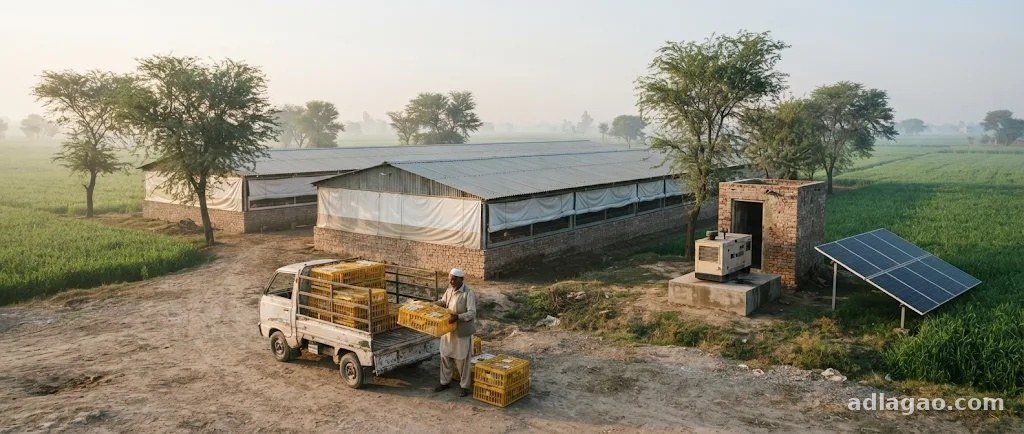
An open shed has brick walls up to a few feet, then curtains. It is cheap to build and suits a small start, but heat, cold and disease hit it harder.
Part 3: Location, land and registration
- Away from homes and other farms. Diseases spread from farm to farm, and neighbours complain about smell and flies. Ask your livestock department about the distance required in your area.
- All-year road for chick, feed and bird trucks, electricity (three-phase for a control shed) and good underground water.
- High, dry land that does not flood. Open sheds are usually built east–west so the sun does not shine straight into the shed.
- Land size (rough): one control shed for 30,000 birds is about 24,000 sq ft (for example 40 × 600 ft); with roads, a store, a generator room and spacing you need roughly one acre. A 5,000-bird open shed needs about 5,000–6,000 sq ft of shed.
- Registration: in Punjab, the Punjab Poultry Production Act 2016 and its rules require every poultry farm to be registered with the livestock department (Poultry Research Institute). In other provinces, ask your provincial livestock department.
- Environment: used litter (rice husk mixed with droppings) must not be dumped in canals or near homes — compost it or sell it to farmers as manure. Bury or burn dead birds in a proper pit.
- Business: get an NTN, keep a bank account for the farm, and keep records of every flock. Banks, including Zarai Taraqiati Bank, give loans for poultry farms — ask for their current terms.
Part 4: The shed and equipment
Space: about 0.75–0.8 sq ft per bird in a control shed and about 1 sq ft per bird in an open shed (a bit more in summer).
Equipment you need:
- Feeders: pan feeders (about one per 40–50 birds) or an automatic chain or pan feeding line.
- Drinkers: nipple drinker lines with a tank and pressure regulators (about one nipple per 10–12 birds), or bell drinkers.
- Brooders / heaters: gas brooders or heaters for the first weeks, with a thermometer at chick height.
- Ventilation: curtains and fans (open shed); tunnel exhaust fans, cooling pads with pumps and a controller (control shed).
- Power: a generator with an automatic start, and solar if you can (Part 7).
- Others: water tank and pump, weighing scale, sprayer for disinfection, footbath at the gate, store for feed and litter, and rice husk or wood shavings for litter.
Rough setup cost (without land):
| Open shed, 5,000 birds | Control shed, 30,000 birds | |
|---|---|---|
| Shed and equipment | about Rs 25–40 lakh | about Rs 3.5–5.5 crore |
| Money for the first flock (chicks, feed, medicine, etc.) | about Rs 37 lakh | about Rs 2 crore |
Many farmers buy feed on credit from dealers, but you still need a large amount of working capital. Get written quotes from two or three shed builders and equipment suppliers before you decide.
Part 5: A flock, step by step
Before the chicks arrive
- Remove the old litter, wash the shed, disinfect it and let it dry. Rest the shed for 10–14 days between flocks.
- Spread fresh litter about 2–3 inches deep, set the feeders and drinkers, and heat the shed for about 24 hours before the chicks come.
The chicks
- Buy from a reputable hatchery. Good chicks are active, dry, bright-eyed and of even size. Ask which vaccines were given at the hatchery.
- Count them and check them as soon as they arrive. Give water at once, then feed.
Temperature (approx.)
- About 32–33°C at chick level in the first days, then about 2–3°C lower each week, down to about 22–24°C by the fourth week.
- Watch the chicks: crowded together under the heater = too cold; spread to the walls, panting = too hot; evenly spread and active = just right.
Feed and water
- Broiler feed comes in stages: pre-starter / starter, grower and finisher. Give clean, fresh water all the time — birds that do not drink do not eat.
- Raise the feeders and drinkers as the birds grow, to the height of their backs.
Growth (a well-run farm, approx.)
| Age | Live weight (approx.) | Temperature (approx.) |
|---|---|---|
| Week 1 | about 0.17–0.19 kg | 32–30°C |
| Week 2 | about 0.43–0.48 kg | 30–28°C |
| Week 3 | about 0.85–0.95 kg | 28–26°C |
| Week 4 | about 1.35–1.5 kg | 26–24°C |
| Week 5 | about 1.9–2.1 kg | 24–22°C |
Weigh a sample of birds every week. If they are behind, check temperature, water, feed quality and health at once.
Selling: most broilers are sold at about 35–42 days, at about 2 kg. Stop medicines in time before sale, as your vet advises.
Part 6: Health, vaccines and biosecurity
Biosecurity — the cheapest medicine:
- One gate, a footbath, and separate shoes and clothes for the shed. No visitors inside, and no other birds or animals near the shed.
- Control rats and wild birds. Keep feed bags closed and dry.
- Remove dead birds every day and dispose of them properly.
- Keep records: deaths, feed used, weights, vaccines and medicines.
Common diseases in Pakistan: Newcastle disease (ND), Gumboro (IBD), infectious bronchitis (IB), hydropericardium (angara), avian influenza (H9), coccidiosis, and breathing and gut infections (CRD, E. coli).
- Vaccines: follow the schedule your poultry vet gives for your area — usually Newcastle, IB and Gumboro, and sometimes others.
- Antibiotics only on a vet's advice, in the right dose, and stop them before sale as advised — leftover medicine in meat is harmful.
- Heat stress kills many birds in open sheds in summer: give cool water, fans and wet curtains, and avoid handling birds in the heat of the day.
- If many birds die suddenly, call a vet and your livestock department at once.
Part 7: Electricity, generator and solar
| Load (approx.) | Control shed, 30,000 birds | Open shed, 5,000 birds |
|---|---|---|
| Fans | 8–12 tunnel exhaust fans, about 1.1 kW each: 9–13 kW | ceiling / pedestal fans: 1–2 kW |
| Cooling pad pumps | about 1 kW | — |
| Lights | about 1 kW | about 0.5 kW |
| Feeding, water and controller | about 1–2 kW | water pump about 0.75 kW |
| Total in summer | about 12–17 kW | about 2–4 kW |
- A generator with automatic start is a must for a control shed. In hot weather, birds in a closed shed can die within minutes if the fans stop.
- Solar lowers the daytime bill: about 15–20 kW of panels for a control shed, or 3–5 kW for a small open shed. The fans also run at night, so solar alone is not enough — keep the grid and the generator.
- Use a certified installer and good wiring, and keep the generator serviced and fuelled.
Part 8: Feasibility — control shed and open shed, cost and profit per flock
What we assumed (November 2026):
| Item | Assumption |
|---|---|
| Day-old chick | about Rs 150 each (hatchery rate in early November 2026 was about Rs 151–153, including Rs 10 excise duty) |
| Feed | about Rs 7,200 per 50 kg bag (Rs 144 per kg) |
| Live broiler rate at the farm | about Rs 360–380 per kg in November 2026 — changes daily |
| Weight at sale | 2.0 kg |
| Feed per kg of weight (FCR) | control shed 1.6, open shed 1.75 |
| Deaths | control shed 3%, open shed 5% |
Cost per chick placed (approx.):
| Cost | Control shed | Open shed |
|---|---|---|
| Chick | Rs 150 | Rs 150 |
| Feed | Rs 461 (3.2 kg) | Rs 504 (3.5 kg) |
| Vaccines and medicine | Rs 20 | Rs 25 |
| Litter | Rs 8 | Rs 8 |
| Brooding heat (gas) | Rs 8 | Rs 15 |
| Electricity / diesel | Rs 15 | Rs 5 |
| Labour | Rs 15 | Rs 15 |
| Other (disinfectant, catching, repairs) | Rs 10 | Rs 10 |
| Total per chick placed | about Rs 687 | about Rs 732 |
| Live weight sold per chick placed | 1.94 kg | 1.90 kg |
| Break-even live rate | about Rs 354 per kg | about Rs 385 per kg |
Profit or loss per flock (before shed costs and loan interest):
| Live rate at the farm | Control shed, 30,000 chicks | Open shed, 5,000 chicks |
|---|---|---|
| Rs 340 per kg | about Rs 8.2 lakh loss | about Rs 4.3 lakh loss |
| Rs 360 per kg | about Rs 3.5 lakh profit | about Rs 2.4 lakh loss |
| Rs 380 per kg | about Rs 15 lakh profit | about Rs 0.5 lakh loss |
| Rs 400 per kg | about Rs 27 lakh profit | about Rs 1.4 lakh profit |
| Rs 430 per kg | about Rs 44 lakh profit | about Rs 4.3 lakh profit |
A year in a control shed: with 6 flocks at an average of Rs 380 per kg, the farm makes roughly Rs 90 lakh before fixed costs. After depreciation of the shed and equipment, repairs and loan interest (roughly Rs 30–40 lakh a year), that leaves about Rs 50–60 lakh, so a Rs 4–5 crore farm takes 7–9 years to pay back. At an average of Rs 400 per kg it is closer to 3–4 years. Small changes in the rate make a very big difference.
A year in an open shed (without control): with 5 flocks of 5,000 chicks, at an average of Rs 400 per kg the farm makes only about Rs 7 lakh a year before fixed costs, and at Rs 380 it loses money. If the family does the work itself (no paid labour), each flock costs about Rs 75,000 less and the break-even rate falls to about Rs 377 per kg. An open shed pays best when its owner keeps costs very low, fills it in the good seasons and keeps deaths down.
What this shows:
- Feed is about two-thirds of the cost. Improving FCR by just 0.1 saves about Rs 29 per bird — about Rs 8.6 lakh per flock of 30,000.
- Every 1% fewer deaths in a 30,000 flock adds about 600 kg of meat — about Rs 2.2 lakh at Rs 370.
- An open shed has a higher cost per kg. Small farmers make it work with family labour, low costs, good seasons and sometimes contract farming. Do not borrow heavily for an open shed.
- Keep a reserve for two or three bad flocks in a row. Rates do fall below the cost of production at times.
Part 9: Staff
- Control shed (30,000): a farm manager or supervisor and 3–4 trained workers.
- Open shed (5,000): one or two workers, often from the family.
- Pay at least the legal minimum wage, train workers in biosecurity and generator use, and keep someone at the farm day and night.
Part 10: Selling and marketing
1. Follow the daily rate. Broiler rates are announced daily and change by city. Compare two or three buyers before you sell.
2. Weigh fairly. Use a checked scale, weigh in front of you, and agree on deductions before loading.
3. Get paid safely. Take payment before loading, or deal only with buyers you know well. Many farmers have lost money to traders who did not pay.
4. More buyers: shops, hotels, caterers and wedding halls (winter and the wedding season bring more demand), and contract farming with a company.
5. Sell the litter. Used litter is good manure — sell it to farmers by the trolley.
6. Advertise. Post your flock on AdLagao with the number of birds, age, average weight and location, so buyers can call you.
Part 11: Risks to plan for
- Feed price jumps — soybean and maize prices and the rupee move feed prices.
- Rate crashes — sometimes the live rate falls below the cost of production for weeks.
- Disease outbreaks — avian influenza, Newcastle and others can wipe out a flock.
- Heat waves, cold and floods — especially for open sheds.
- Power failures — deadly in control sheds without a generator.
- Unpaid bills and theft — choose buyers carefully and keep the farm guarded.
Buying, selling and hiring on AdLagao
- Chicks, flocks and live birds: Hens & Poultry.
- Feed: Fodder & Animal Feed.
- Feeders, drinkers, fans and other farm equipment: Farm Machinery.
- Generators and solar: Generators, UPS & Solar, and installers in Solar, UPS & Inverter Services.
- Land for a farm: Agricultural Land or Land on Lease — or buy a running farm in Business for Sale.
- Farm managers and workers: Job Vacancies.
Used sheds and equipment can save a lot: see them working, check the fans, generator and wiring, and never pay a full advance before you have seen everything. Read how to avoid online fraud.
Planning a poultry farm? Post a free ad for what you need — and share this guide with someone who wants to start one.
Ads you may like


More articles

 🐄 AnimalsEN · اردو
Businesses for Goat Farming
Encourage people and businesses for Goat Farming
2026-11-02 · 3 min read
 🐄 AnimalsEN · اردو
Green Conure Parrots in Pakistan: Buying and Care Guide for Beginners
Thinking of buying a conure? Which type to choose, how to check a healthy bird, safe buying, food, cage and care in Pak…
2026-10-25 · 5 min read